
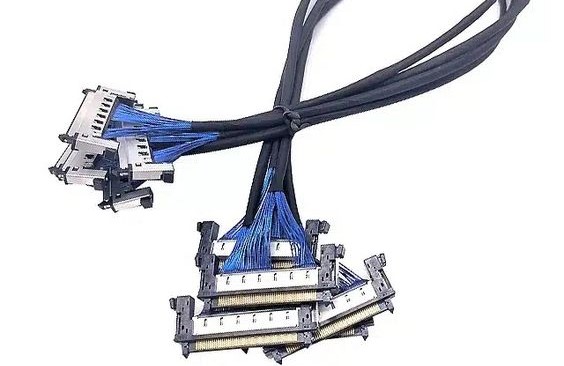
A robotic wire harness must do more than carry electrical power and signals. It may need to bend, twist, accelerate, vibrate, and move repeatedly for millions of cycles while maintaining reliable electrical performance.
This makes material and component selection especially important.
A high flex wire harness is typically engineered as a complete system consisting of conductors, insulation, shielding, fillers, jackets, terminals, connectors, strain relief, and protective components. The performance of the finished harness depends on how these elements work together under dynamic motion.
Understanding the materials and components used in high-flex construction can help engineers select the right harness for robotic arms, automated machinery, cable carriers, and other moving equipment.
What Materials Are Used in a High Flex Wire Harness?
The main materials in a high flex wire harness typically include:
- Copper conductors
- Conductor plating
- Flexible insulation
- Shielding materials
- Fillers and separators
- Outer jackets
- Reinforcement materials
- Connector and terminal materials
- Strain-relief components
Each component has a different function, but mechanical flexibility is a common consideration.
A material that performs well electrically may not necessarily provide the required mechanical durability under continuous flexing.
1. Conductors: The Foundation of Flexibility
The conductor is one of the most important components in a high-flex cable.
Copper is widely used because it provides good electrical conductivity combined with mechanical flexibility.
However, the way copper is constructed can have a major effect on flex performance.
Solid Conductors vs. Stranded Conductors
A solid conductor consists of a single piece of metal.
It can be suitable for fixed installations but is generally less appropriate for applications involving continuous mechanical movement.
Stranded conductors consist of multiple smaller wires.
Because the individual strands can move relative to one another, stranded construction can provide greater flexibility.
For demanding robotic applications, manufacturers may use fine-stranded or highly flexible conductor constructions designed specifically for repeated movement.
Stranding Structure Matters
Two cables can have the same conductor cross-sectional area but different flex performance because their strand sizes and constructions differ.
Important factors include:
- Strand diameter
- Number of strands
- Stranding pitch
- Lay direction
- Conductor geometry
- Material hardness
The conductor should therefore be selected according to the expected bending and torsional conditions rather than electrical specifications alone.
2. Copper Plating and Surface Treatment
Copper conductors may be plated with materials such as tin or other finishes depending on the application.
Plating can provide benefits including:
- Corrosion resistance
- Improved solderability
- Surface protection
- Compatibility with terminals
However, the plating process and conductor construction must be compatible with repeated flexing.
For a high flex wire harness, electrical performance and mechanical durability need to be considered together.
3. Insulation Materials
The insulation surrounds the conductor and provides electrical isolation.
In a dynamic application, insulation also becomes part of the mechanical system.
It must withstand repeated deformation without excessive cracking, hardening, or loss of electrical properties.
Common insulation and jacketing materials used in flexible cable construction can include:
- PVC
- PUR
- TPE
- TPU
- Fluoropolymers
- Other specialized elastomeric materials
The appropriate material depends on the operating environment.
PVC
PVC is widely used for general-purpose cables because of its relatively low cost and broad availability.
However, not every PVC formulation is intended for continuous dynamic flexing. A high-flex application requires a formulation and construction appropriate for the expected motion.
PUR / TPU
Polyurethane-based materials are frequently used where flexibility, abrasion resistance, and environmental durability are important.
They can be useful in industrial automation and robotic applications where the cable may experience repeated movement and mechanical wear.
TPE
Thermoplastic elastomers can provide a useful combination of flexibility and environmental resistance.
Specific performance varies considerably by formulation, so material selection should be based on the actual application requirements.
Fluoropolymers
Fluoropolymer materials can provide strong temperature and chemical resistance.
They may be considered for applications where environmental conditions are more demanding, although cost and mechanical requirements must also be evaluated.
4. Shielding Materials
Robotic systems increasingly combine motors, sensors, communication systems, and high-speed data interfaces.
This can create electromagnetic compatibility challenges.
A high flex wire harness may therefore require shielding.
Common shielding constructions include:
- Braided copper shields
- Foil shields
- Spiral shields
- Combination foil and braid shields
Shield construction can affect both electrical performance and mechanical flexibility.
A shield designed for a fixed cable installation may not necessarily provide the same performance under continuous flexing.
For moving robotic applications, shielding must be designed to tolerate the expected mechanical movement while maintaining adequate coverage and electrical continuity.
5. Fillers and Separators
Fillers and separators are often overlooked because they are not directly involved in carrying electrical current.
However, they can influence the mechanical behavior of the cable.
Their functions may include:
- Maintaining cable geometry
- Separating conductors
- Reducing internal movement
- Supporting roundness
- Controlling bending behavior
- Reducing mechanical stress between components
In a high flex wire harness, internal cable construction can be just as important as the outer jacket.
Poorly controlled internal movement can create localized stress during repeated bending.
6. Outer Jacket
The outer jacket protects the internal components from the environment and mechanical damage.
For robotic applications, the jacket may need to resist:
- Repeated bending
- Abrasion
- Oil
- Coolants
- Chemicals
- Temperature changes
- Moisture
- Mechanical impact
The jacket must also remain flexible over the expected operating temperature range.
A material that becomes significantly harder at low temperature or softens excessively at high temperature can change the cable’s mechanical behavior.
7. Reinforcement Materials
Some high-flex cable constructions use reinforcement materials to improve mechanical performance.
Depending on the design, reinforcement may help control tensile loads or reduce stress transferred to the conductors.
Examples can include specialized fibers or strength members.
The reinforcement system should be designed carefully because adding strength does not automatically improve flex life. The objective is to control mechanical loads without unnecessarily restricting cable movement.
8. Connectors and Terminals
The cable itself is only one part of a robotic harness.
Connectors and terminals can become potential failure points when the assembly is repeatedly moved.
Important considerations include:
- Terminal crimp quality
- Contact retention
- Connector locking
- Connector weight
- Cable exit direction
- Strain relief
- Vibration resistance
A high-flex cable connected to a poorly designed termination may still experience premature failure.
The connector and cable should therefore be treated as one mechanical system.
9. Strain Relief
Strain relief helps prevent excessive mechanical loads from being transferred directly to the termination area.
Without appropriate strain relief, repeated bending can concentrate stress near the connector.
A good strain-relief design should control:
- Bend location
- Cable movement
- Tensile loading
- Connector transition
- Minimum bend radius
This is particularly important for robotic applications where movement occurs close to the connector.
10. Protective Sleeves and Cable Management
Some robotic harnesses use additional protective components such as:
- Protective sleeving
- Braided sleeves
- Corrugated tubing
- Cable carriers
- Spiral wraps
- Drag-chain systems
These components can protect the harness from abrasion and environmental exposure.
However, protection should not unnecessarily restrict the cable’s intended movement.
A protective sleeve that is too stiff or incorrectly sized can increase bending forces and reduce the effective flexibility of the assembly.
Material Selection by Application
There is no single material combination that is ideal for every high-flex wire harness.
The selection depends on the application.
| Application | Important Material Considerations |
|---|---|
| Industrial robot | Flexibility, abrasion, oil resistance |
| Cable carrier | Continuous bending, wear resistance |
| Collaborative robot | Flexibility, compact construction, safety |
| Medical robot | Flexibility, cleanliness, chemical resistance |
| Automotive robot | Temperature, oil, vibration, flex life |
| Semiconductor equipment | Cleanliness, chemical resistance, precise motion |
| High-speed robotic system | Flexibility plus shielding and signal integrity |
The correct material combination should be determined from the complete operating environment.
How Materials Affect High Flex Wire Harness Cycle Life
Material selection directly affects the mechanical life of the harness.
Consider a cable that operates at a small dynamic bend radius.
During every movement, the conductor, insulation, shielding, and jacket experience mechanical deformation.
Over millions of cycles, small amounts of damage can accumulate.
The failure mechanism may involve:
- Conductor fatigue
- Strand breakage
- Insulation cracking
- Shield fatigue
- Jacket wear
- Internal component displacement
- Terminal fatigue
- Connector damage
This means that improving the material of only one component may not solve the overall problem.
The entire cable construction must be optimized.
Mechanical Design Is as Important as Material Selection
Even the best materials can fail if the harness is poorly routed.
For a high flex wire harness, engineers should consider:
Dynamic Bend Radius
The cable should operate within an appropriate dynamic bend radius.
Motion Type
Determine whether the cable experiences:
- Bending
- Torsion
- Combination bending and torsion
- Linear movement
- Continuous reciprocating motion
Motion Speed
Higher motion speeds can increase mechanical stress and heat generation.
Cycle Count
Estimate the total number of expected cycles over the intended service life.
Temperature
Material properties can change with temperature, affecting flexibility and durability.
Routing
The cable should be routed so that it does not experience unintended kinks, compression, or excessive twisting.
How to Choose Components for a High Flex Wire Harness
A practical selection process can start with the following questions:
1. How many cycles are required?
Calculate the expected number of flex cycles over the equipment’s service life.
2. What type of motion occurs?
Identify bending, torsion, rotation, or combined movement.
3. What is the dynamic bend radius?
Determine the smallest radius the cable will experience during operation.
4. What environmental conditions exist?
Consider temperature, oil, coolant, chemicals, moisture, abrasion, and other environmental factors.
5. What electrical performance is required?
Consider voltage, current, impedance, shielding, data rate, and signal integrity.
6. How will the cable be terminated?
Select appropriate connectors, terminals, and strain-relief methods.
7. How will the complete assembly be tested?
The final harness should be validated under conditions representative of the actual application.
High Flex Wire Harness Materials: A System-Level Approach
One of the most important principles in high-flex design is that no single component determines the entire service life.
For example, a harness may use highly flexible copper conductors but still experience early failure because of:
- An unsuitable jacket
- Poor shielding construction
- Excessive connector stress
- Inadequate strain relief
- Incorrect routing
- A bend radius that is too small
Conversely, an excellent cable construction may perform poorly if installed outside its intended operating conditions.
The best results come from treating the high flex wire harness as a complete mechanical and electrical system.
Conclusion
The materials and components used in a high flex wire harness have a direct influence on its flexibility, electrical performance, environmental resistance, and service life.
Key components include:
- Fine-stranded copper conductors
- Flexible insulation
- Dynamic-rated shielding
- Internal fillers and separators
- Flexible outer jackets
- Reinforcement materials
- Reliable terminals and connectors
- Proper strain relief
- Appropriate cable-management components
For robotic and automated equipment, material selection should always be considered together with bend radius, torsion, motion speed, temperature, routing, and expected cycle life.
A high flex wire harness is therefore not simply a flexible cable. It is a carefully engineered assembly in which the materials, construction, termination, and installation all contribute to long-term dynamic performance.


