
Introduction
Artificial Intelligence (AI) is transforming data centers at an unprecedented pace. The rapid adoption of large language models, generative AI, and high-performance computing (HPC) is driving the need for faster and more efficient network infrastructure. As AI clusters scale from hundreds to thousands of GPUs, traditional networking solutions are reaching their limits.
To support these demanding workloads, the industry is transitioning from 400G networks to 800G Ethernet and preparing for the next generation of 1.6T interconnects. At the heart of this evolution are custom cable assemblies that provide the high-speed, low-latency, and reliable connectivity required for AI training and inference environments.
In this article, we explore how custom cable assemblies enable 800G and 1.6T AI networks and why cable design has become a critical factor in next-generation data center performance.
The Rise of AI-Driven Network Bandwidth Requirements
Modern AI models require massive amounts of data exchange between GPUs, CPUs, memory systems, and storage devices. During distributed training, thousands of processors communicate continuously to synchronize model parameters and share datasets.
As AI workloads grow larger:
- Network traffic increases exponentially.
- Latency becomes a critical performance bottleneck.
- Signal integrity requirements become more demanding.
- Power consumption must be carefully managed.
To address these challenges, hyperscale data centers are deploying:
- 800G Ethernet switches
- 800G InfiniBand networks
- Co-packaged optics
- Advanced GPU interconnect fabrics
- Emerging 1.6T networking architectures
These technologies rely heavily on precision-engineered cable assemblies capable of maintaining signal quality at extremely high data rates.
Why Standard Cables Are No Longer Enough
Traditional off-the-shelf cables were not designed for the electrical requirements of modern AI infrastructure.
At 800G and beyond, engineers must consider:
Signal Loss
Higher frequencies experience greater insertion loss, which can degrade performance and increase bit error rates.
Electromagnetic Interference (EMI)
Dense server racks and high-power computing equipment generate substantial electromagnetic noise that can impact signal transmission.
Crosstalk
Closely packed conductors can interfere with each other, reducing signal quality and increasing retransmissions.
Thermal Challenges
AI servers often operate at high power densities, creating elevated temperatures that affect cable performance and longevity.
Custom cable assemblies are specifically engineered to overcome these limitations.
Key Features of High-Speed Custom Cable Assemblies
Advanced Conductor Materials
Material selection directly affects signal performance.
Common conductor options include:
- Silver-plated copper
- Tin-plated copper
- Bare copper
- High-purity copper alloys
Silver-plated conductors are particularly valuable for high-frequency applications because they reduce conductor losses and improve signal transmission.
Precision Impedance Control
Maintaining consistent impedance is critical for high-speed signaling.
Custom cable manufacturers carefully control:
- Conductor spacing
- Dielectric materials
- Shielding structures
- Connector transitions
Proper impedance matching minimizes reflections and ensures optimal data transmission.
Enhanced Shielding
AI networking environments contain numerous sources of electromagnetic interference.
Custom cable assemblies may incorporate:
- Aluminum foil shielding
- Braided shielding
- Multi-layer EMI protection
- Grounding enhancements
These features help preserve signal integrity while reducing noise susceptibility.
Optimized Connector Design
Connectors often become the weakest link in high-speed systems.
Custom solutions can include:
- Low-loss connector interfaces
- High-density connector layouts
- Optimized contact plating
- Precision termination techniques
This ensures reliable performance across thousands of insertion cycles.
Cable Technologies Used in AI Networks
High-Speed Twinax Cable Assemblies
Twinax cables remain a popular choice for short-reach AI networking applications.
Advantages include:
- Low latency
- Excellent signal integrity
- Cost-effective deployment
- Reduced power consumption
They are commonly used in:
- Direct Attach Copper (DAC) solutions
- Switch-to-server connections
- Rack-scale AI architectures
Active Copper Cables (ACC)
As bandwidth requirements increase, active copper cables provide additional signal conditioning and equalization.
Benefits include:
- Extended reach
- Improved signal quality
- Lower power compared to some optical solutions
Active Optical Cables (AOC)
For longer distances, active optical cables offer:
- Minimal signal loss
- Immunity to EMI
- Lightweight construction
- Scalability for future network upgrades
Many 800G deployments already rely on AOC technology.
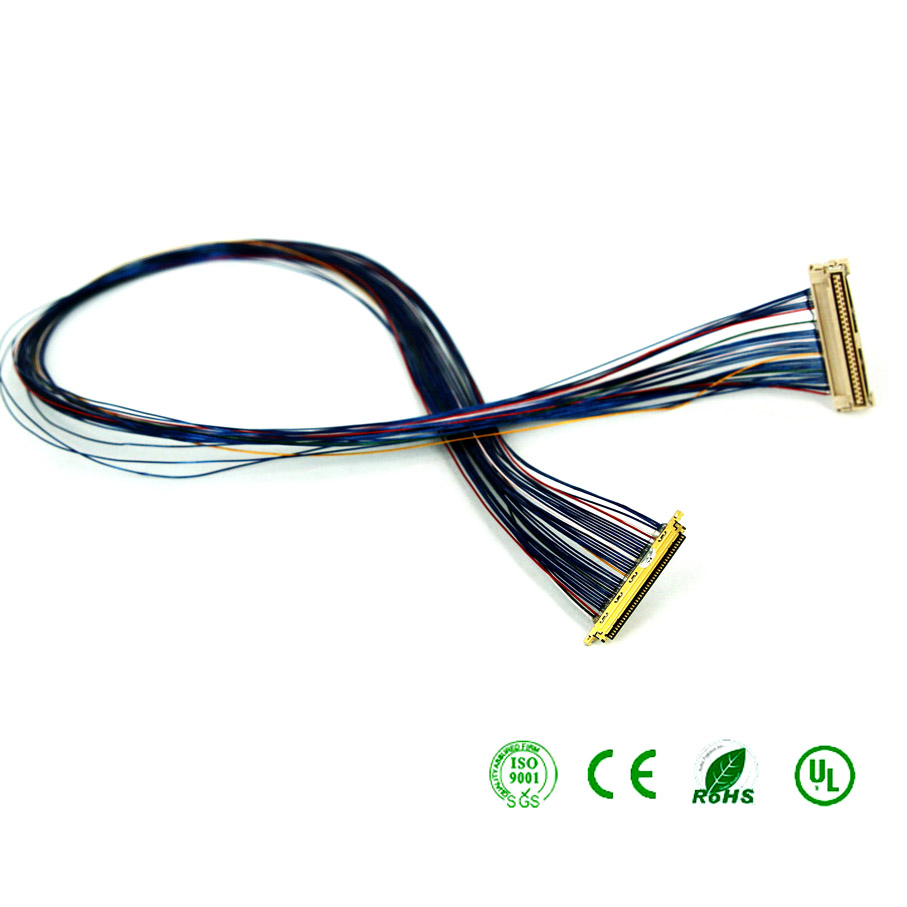
Micro Coax Cable Assemblies
Micro coax technology plays an increasingly important role in:
- High-density computing systems
- Internal server interconnects
- Accelerator modules
- Advanced networking equipment
Their small size and excellent shielding characteristics make them ideal for compact AI hardware designs.
Preparing for 1.6T Networks
The transition to 1.6T networking introduces even greater engineering challenges.
Expected requirements include:
- PAM4 and future modulation schemes
- Higher channel frequencies
- Tighter loss budgets
- Advanced thermal management
- Increased connector density
Cable assemblies for 1.6T systems must deliver:
- Ultra-low insertion loss
- Exceptional return loss performance
- Enhanced EMI shielding
- Precision manufacturing tolerances
Manufacturers capable of custom engineering and rigorous testing will play a critical role in supporting these next-generation deployments.
Why OEMs Choose Custom Cable Assemblies
Custom cable solutions offer several advantages over standard products:
Performance Optimization
Each assembly can be tailored to specific electrical requirements.
Space Savings
Custom routing and cable geometry improve airflow and rack density.
Improved Reliability
Purpose-built assemblies reduce mechanical stress and increase service life.
Faster Integration
Custom connector configurations simplify installation and reduce deployment time.
Future-Proof Design
OEMs can prepare for evolving standards without redesigning entire systems.
How Darlox Supports High-Speed AI Connectivity
As a specialized manufacturer of custom cable assemblies, Darlox provides solutions for demanding high-speed applications, including:
- Micro Coax Cable Assemblies
- LVDS Cable Assemblies
- eDP Cable Assemblies
- Custom FFC/FPC Solutions
- High-Density Wire Harnesses
With expertise in signal integrity, shielding design, precision manufacturing, and rapid prototyping, Darlox helps OEMs develop reliable interconnect solutions for AI servers, networking equipment, robotics, medical electronics, and next-generation computing platforms.
Conclusion
The evolution from 400G to 800G and eventually 1.6T networks is reshaping the data center landscape. As AI workloads continue to grow, reliable high-speed connectivity becomes increasingly important.
Custom cable assemblies are no longer simple supporting components—they are strategic enablers of network performance. Through advanced materials, precision engineering, optimized shielding, and application-specific design, these assemblies help maintain signal integrity, reduce latency, and support the massive bandwidth demands of modern AI infrastructure.
Organizations investing in next-generation AI systems should view cable assembly design as a critical element of overall network architecture. The right custom cable partner can make the difference between a system that merely functions and one that delivers maximum performance at scale.


